I had an interesting experience yesterday while I was at the main office of the Bank of Bhutan in Thimphu. I was there to buy USD800. After getting the necessary approvals from the Royal Monetary Authority, I took my turn at the counter where the bank officials did their routine processings. The next stop was with a gentleman who then actually handed over to the clients the actual foreign currency to complete the transaction.
Here's the interesting part, he pulls out USD300 travellers cheques and another USD500 and sums up my total to $800 accurately. As I re-count the money I realize that four bills of USD50 denominations in addition to three USD100 bills had also been thrown in to make the total of USD800. On enquiring, not only does he tell me that the exchange rate for the USD100 bill and USD50 bill were equal but he kindly reminded me that I was lucky to be in a position to have even that. That statement particularly became the high light of my own personal experience of the customer service at the Bank of Bhutan, Thimphu. I did try and clarify with the General Manager about the differences in the exchange rates of these two bills of different denominations, but he explained to me that the Royal Monetary Authority had not supplied the Bank with enough bills and instead had been asked to distribute these assorted bills to the customers in a mixed fashion. I could not really get a clear picture as to what a good mix was talking to the general manager but it occurs to me that perhaps, it's not right for the customers to have to pay the equivalent exchange rate for USD100 bills when one is provided with bills of other denominations whose value is below what has been paid for. The general manager also referred to earlier complaints by customers and that since then they had stopped issuing USD bills of smaller denominations but USD 50s still remained acceptable.
Being able to acquire foreign exchange in Bhutan is a right conferred to each Bhutanese although some people may like to refer to it as luck (an astounding feat) but more critical here is the flaw in the system where one pays for product A and is supplied with product B which values less than the former, in a simple logic of transaction.
My experience yesterday has certainly brought this anamoly in the system to my notice and I hope this avid effort from my side helps bring it to the notice of others as well as I will be writing to all concerned.
This piece of writing is intended only to high light something that could be considered as "improvable" for the benefit of all and not to try and tarnish anyone or any organization.
Thursday, January 21, 2010


Monday, January 18, 2010
GNH and being Bhutanese

One often finds there is so much discussion on and about Gross National Happiness or GNH where ever the Bhutanese inteligensia is said to be found. I do not disagree with it's significance given especially the deep and powerful impact on all our lives that GNH as the core givernance and development philosophy commands. It is only befitting that such an issue be discussed at all levels of society more than ever now.
Thinking about Happiness, one is inevitably confronted with the question of the definition and understanding of Happiness in context of persons, people and ultimately communities. It is in this light that it is absolutely critical that one needs to first understand people and communities before even beggining to discuss general happiness as a subject.
In arriving at what GNH now means to a Bhutanese, we perhaps might need to understand what being Bhutanese is all about. Maybe then GNH can truly be said to have worked it's way into the very social fabric of the Bhutanese life. Perhaps then GNH would mean more to invidials as Bhutanese and as one large community.
Even as academics and great thinkers discuss GNH; more often than not one would find that for someone who has no technical understanding of GNH and it's nuances find themselves simply lost. Someone like that would probably think of happiness in his or her context which is only logical. In identifying and characterizing Bhutaneseness, we are then trying to characterize a commnunity which is the agrregation of Bhutanese individuals.
One would find that even though we have GNH in our constitution and every other important document in the country, many ordinary Bhutanese still do not understand how to relate to GNH. Does GNH leave room for individual happiness or is it only as one large community or it is the one and the samething?
The four pillars seem fine in the order of the priority but really, why is that ordinary Bhutanese can not find themselves to relate to them easily.
Sunday, January 17, 2010
Entertainment for thothormi site workers


Between my trip to Thothormi (Lunana) and now, I have had a lot of time to think and I thought this issue was importnat and hopefully, I will be able to write something to this effect in one of the papers. This is just an attempt to pool together my thoughts on the subject.
The task of removing huge boulders and also breaking them; working in the very very cold waters of thothormi lake is a vert difficult job. While I hiked upto the summit, I realised it was a good distance for the workers each morning, possibly about an hour and a half. Although this may seem like a good idea at first, one soon realises that the hard work once at the site needs all the energy that can be conjured. I hear that next camp site will be closer to the lake, that should make it easier to save some energy walking.
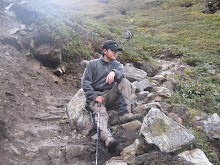
I learnt during my visit that initially the idea had been to engage the workers from 0900 hrs till 1600 hrs with an hour's break for lunch like anywhere else. However, the management later arrived at a decision to execute the labour work on contract, allowing for flexi-hours work. Sundays still remain a holiday and other free times often one would run into many workers wandering around thanza locality and beyond. Thanza is the place in the picture where the camp is posted.
Imagine bringing in some 300 people who mostly do not come from the locality into a community. Imagine then that they have hours to spend with not much to do after working. They go out looking for something to do obviously.When one thinks of it on the surface, one would easily be lead to believe that these workers are trouble makers, thinking of the times they may have gotten drunk and caused comotions. Imagine living in a very very secluded place, cold and harsh weather conditions, not the most apetizing of meals, difficult working conditions and after add all that, no family to return to or any engaging entertainment, in a place like lunana, there arent many things one could do as days pass by.
While I was sitting there, watching these workers at work, I heard a radio (walkie-talkie) crackle and then a voice. I was transported back to Thimphu for a second, listening to Kuzoo on the FM radio. I realised quickly it was the radio operator at the base camp who player some music over the walkies and the music echoed around the site. When the song completed, the operator called out to listeners to make requests and obediently, our guide named a song and dedicated it to the workers, once again, the site echoed with the song and it seemed almost like easier somehow to work.
Entertainment to occupy time in a more accpetable fashion is what I am talking about. Movie screenings, television programmes (and I saw people play khuru) and some other forms of entertainment would benefit everyone greatly. The camp leaders would have less worries and the workers would be happier works by that much. Productivity would increase and the gross savings of the families of the workers there would greatly improve not to mention the mishaps that could be avoided.
Thursday, January 14, 2010
Corruption : High Risk and Low Gain - Thinking in my own head
This is a reference to recent spurt of news on mines and how agencies have failed to clarify in the minds of the people doubts about the system's unclear, opaque and confusing buck passing.Fines have been levied and warnings made out; such stories come to light with each edition of news prints (thanks to committed works by journalists). And on the other hand we say we want to turn corruption into a high risk but low gain prospect.
Would fining such serious gaps mean we are making corruption a High Risk and Low Gain prospects for amassing quick wealth? Are warnings enough? Wouldnt these actions sent out messages to others that corruption is worth it if by paying a small fine and perservering through some warnings could fetch a good chunk of wealth (proceeds of corruption)? Most people would know that mines as natural resources belong to the entire nation and allowing them to be misused without benefitting the masses (in terms of royalties and other fees) means violating the rights of the common Bhutanese? As someone with no knowledge I can only guess that even 1 single day of activity and transaction at a mine site would translate into 1000s of Ngultrums and here we are talking of a tiny winy fine and a warning which may continue again in the future.
The example maybe of mines for now but, really the enforcement needs to be better in other fields too. Otherwise this may sent out a very very wrong message and become the source of rising corruption in Bhutan.
Would fining such serious gaps mean we are making corruption a High Risk and Low Gain prospects for amassing quick wealth? Are warnings enough? Wouldnt these actions sent out messages to others that corruption is worth it if by paying a small fine and perservering through some warnings could fetch a good chunk of wealth (proceeds of corruption)? Most people would know that mines as natural resources belong to the entire nation and allowing them to be misused without benefitting the masses (in terms of royalties and other fees) means violating the rights of the common Bhutanese? As someone with no knowledge I can only guess that even 1 single day of activity and transaction at a mine site would translate into 1000s of Ngultrums and here we are talking of a tiny winy fine and a warning which may continue again in the future.
The example maybe of mines for now but, really the enforcement needs to be better in other fields too. Otherwise this may sent out a very very wrong message and become the source of rising corruption in Bhutan.
Could MPs have been another agency at the GLOF inception workshop
.jpg)
An inception workshop was conducted in Punakha with representation from various agencies of the Government and the UN system in Bhutan on January 14, 2010. I have come to understand that an Early Warning System (work-in-progress) was also discussed for the benefit of the people of the 5 dzongkhags.
GLOF stands as the biggest natural disaster threat to us and perhaps, involving elected representatives from the concerned dzongkhags would have been meaningful and helpful in the implementation of the project, however small the contribution may have been. The locals need to be sensitised in all ways possible and one could see some concerted effort towards that objective in addition. As someone who has visited the GLOF identified thothormi lake project site at lunana in Gasa, I can appreciate the effort agencies have been expending, however, teaming up in such matters can only bring benefits.
There could be other such matters where MPs could contribute in their little ways when it concerns their constituencies and much more. One might want to consider the Parliament as another agency in the country to contribute as team players and not an isolated and compartmentalized institution with a separate goal of legislation only.
Wednesday, January 13, 2010
1st Annual Nomad Festival in Nagsephel, Bumthang

The 1st Annual Nomoad Festival was organized in Bumthang by the Cenn. Park and consisted a congregation of 8 regional nomads.
It was interesting for me to learn about a lot of the projects the Government continues to support in these communities and gives one an idea of the other possible support in future.
The homestay programme needs to improve in a lot of ways but if one just ones to enjoy warm Bhutanes hospitality, I would say it's ready but for the ones expecting along with that some degree of modern comfort of a farmhouse, it's got some way to go but in anycase, I think it's a good start and hopefully, by the next festival, it would be only gotten better.
Perhaps then other districts could benefit from it.
Catching Gasa's 1st Snowfall

The 102nd National Day celebrations continued after December 17 with a 2 day archery match amongst the public, their representatives and civil servants. It was a way to pay tribute and celebrate Bhutan and being Bhutanese.
The morning of the 1st day of the match saw Gasa white and fluffy and shooting arrows in the whiteness was a most memorable way to celebrate and end the 102nd National Day celebrations. Gasa received her 1st snowfall on December 18, 12 days before the rest of Bhutan received hers.
Subscribe to:
Posts (Atom)